
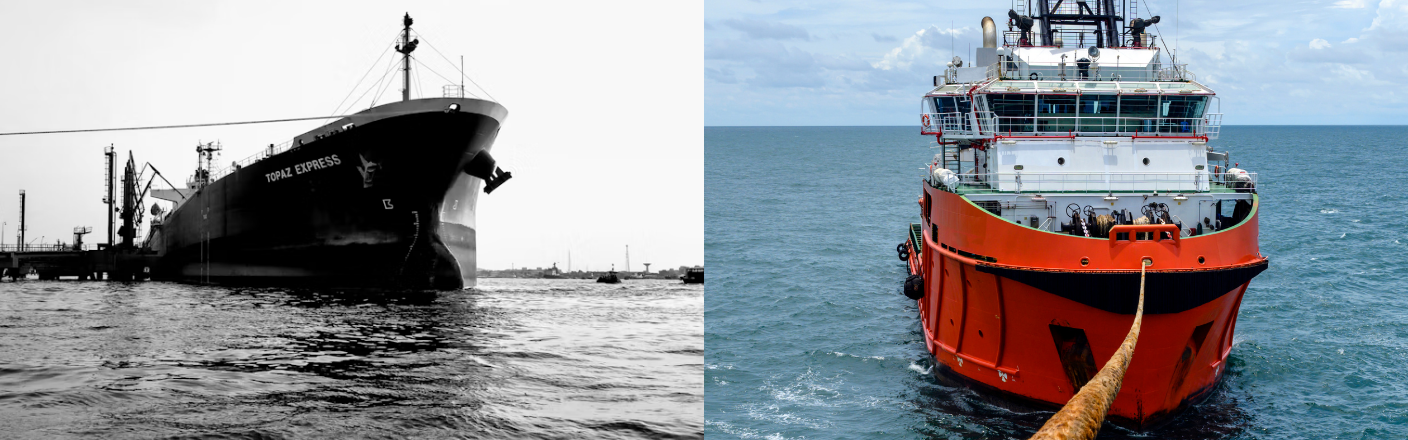
Offshore support vessels (OSVs) are specialized ships that have underpinned the offshore oil and gas industry since its inception. The offshore industry itself dates back over a century: early wells were drilled from piers on California’s coast in the 1890s and 1910s, and by 1947 Kerr-McGee’s Kermac platform drilled the first well beyond sight of land in the Gulf of Mexico.
In 1949 Azerbaijan’s Neft Daşları (“Oily Rocks”) became the world’s first offshore oil platform, marking a major milestone. Over the following decades, exploration expanded from the Gulf of Mexico into the North Sea (oil from the Argyll field in 1975) and worldwide. This expansion created a critical need for vessels to transport crew, fuel, water, drilling fluids and equipment to remote rigs and platforms.
The Rise of Offshore Support Vessels
The first purpose-built OSV, Ebb Tide, launched in 1956, established the blueprint for modern platform supply vessels. Designed to carry equipment to offshore platforms, it featured a forward wheelhouse and large open deck—design elements still standard today. Over the next decades, the OSV fleet expanded to include:
- Platform Supply Vessels (PSVs): Transporting fuel, water, drilling mud, and cargo.
- Anchor Handling/Tug-Supply (AHTS) vessels: Towing and positioning drilling rigs and anchors.
- Crew and standby vessels: Moving personnel and providing emergency support.
- Multi-purpose support vessels: Handling subsea construction, pipelay, diving operations, firefighting, and oil spill response.
By the 2000s, thousands of OSVs operated globally, supporting projects from the Gulf of Mexico to the North Sea, Brazil, West Africa, and Asia. Companies like Tidewater, Maersk, Bourbon, Edison Chouest, and DOF became industry leaders.
Despite this growth, traditional chartering was slow and fragmented. Shipowners, charterers and brokers typically relied on dated vessel availability lists, emailed inquiries and brokers’ phone calls to arrange spot charters. These manual processes could leave rigs waiting for supplies or OSVs sitting idle with no job. The industry has long relied on manual updates, fragmented emails, and inconsistent vessel lists. In practice this meant lost time and inefficiency: every unscheduled repositioning or unfilled voyage wasted fuel and money. For many companies, the offshore support vessel market was effectively a maze of disconnected communication channels.
Enter Nauticworx (Sept 2024): A digital game-changer.
In September 2024, at the SMM maritime trade show in Hamburg, Nauticworx – a Rotterdam-based digital startup – launched a new chartering platform for OSVs. Unlike previous brokers or email chains, Nauticworx offers a real-time online marketplace. Its interface allows fleet owners to post available OSVs and charterers to post project requirements, then automatically match them (anonymously) in a single system.
The platform connects vessel owners, charterers, and brokers all in one place, enabling efficient, secure, and sustainable chartering experiences. At launch the company emphasized that users stay anonymous until they choose to connect, and that there are no commissions – just a flat subscription fee (unlike traditional brokerage fees).
Key Nauticworx features include:
- Real-time matching: Owners post vessel data and charterers post project needs; intelligent algorithms match them instantly, without manual sorting.
- Efficiency and utilization: Idle vessels become visible and hireable. Nauticworx helps owners maximize fleet utilization and charterers access available tonnage faster, boosting operational efficiency and cutting downtime.
- 800 NM sustainability: By linking projects to only local or regional ships, the platform cuts needless repositioning. Analysts note this radius-driven approach “minimiz[es] unnecessary mobilization…resulting in reduced costs [and] lower emissions”.
- Clear costs: There are no hidden fees or commissions on deals (unlike traditional brokerages), so every participant retains full value of each hire.
Before vs. After Nauticworx
Prior to Nauticworx, an OSV owner might fax a schedule to brokers and wait; after Nauticworx, the same owner logs in, updates availability, and is instantly notified of matching requests. Likewise, a charterer needing a PSV off Angola no longer sifts through fragmented lists – instead they see all nearby available vessels at a glance.
This transforms chartering from a costly, manual ordeal into a data-driven, efficient process. In other words, the offshore support vessel industry of the 1950s–2020s – one of barge-to-ship evolution and global fleet expansion – is now evolving again into a digital, greener era. Nauticworx is widely described as a useful tool that enhances profitability, sustainability, and overall operational efficiency for OSV operators.
Conclusion
From the first derricks on wooden piers to today’s electric-drive PSVs, offshore operations have always pushed technological and logistical boundaries. Offshore support vessels grew from humble converted barges into a sophisticated global fleet, owned by the likes of Tidewater, Maersk, Bourbon and many others. The advent of Nauticworx in 2024 represents the latest milestone: by bringing chartering onto an integrated digital platform, it makes vessel-project matching faster, cleaner and more efficient than ever. In short, Nauticworx has reshaped the offshore support vessel market – creating a modern network that contrasts sharply with the pre-digital, paper-based world of the past.